
Why Welding Machine Calibration Matters More Than Ever in Modern Manufacturing

Manufacturing industries today operate in an environment where product quality, traceability, process consistency, and operational reliability are more important than ever before. From pressure vessels and pipelines to automobiles, aerospace components, shipbuilding, and heavy engineering, welding plays a vital role in ensuring structural integrity.
While organizations routinely calibrate weighing balances, pressure gauges, temperature sensors, and electrical instruments, Welding Machine Calibration is still an emerging discipline in many parts of the world, including India.
As industries adopt stricter quality management systems and customers demand greater process control, the importance of Welding Machine Calibration continues to grow.
What Is Welding Machine Calibration?
Welding Machine Calibration is the process of verifying that a welding power source delivers electrical output in accordance with its specified settings.
The objective is to confirm that the welding machine operates consistently and produces reliable current and voltage under defined operating conditions.
Proper calibration supports:
Process consistency
Equipment verification
Quality assurance
Repeatable welding operations
Documented maintenance practices
Although calibration practices vary depending on industry requirements and applicable standards, maintaining accurate welding equipment contributes to overall manufacturing quality.
Why Welding Machine Calibration Is Becoming More Important
Manufacturing industries are increasingly expected to demonstrate greater control over production processes.
Several factors are driving increased attention toward Welding Machine Calibration.
Higher Customer Expectations
Customers increasingly expect suppliers to maintain documented quality systems and reliable manufacturing processes.
Improved Process Consistency
Accurate welding equipment helps support consistent welding parameters across production batches.
Better Equipment Performance Monitoring
Regular calibration and verification can assist maintenance teams in identifying equipment deviations before they affect production.
Enhanced Documentationz
Documented calibration activities strengthen internal maintenance records and quality management systems.
Industries Where Welding Machine Calibration Is Critical
The importance of Welding Machine Calibration extends across numerous industries.
Oil & Gas
Pipelines, pressure vessels, refineries, and petrochemical equipment rely heavily on high-quality welding.
Shipbuilding
Shipyards use hundreds of welding machines for hull fabrication and structural assembly.
Defence Manufacturing
Mission-critical components require consistent manufacturing processes.
Aerospace
Aircraft structures demand precise welding parameters and documented quality control.
Heavy Engineering
Boilers, reactors, tanks, and industrial machinery all depend on reliable welding.
Railway Manufacturing
Rolling stock and infrastructure projects require controlled fabrication processes.
Renewable Energy
Wind towers, solar structures, and energy infrastructure involve extensive welding activities.
Challenges of Traditional Welding Machine Verification
Many organizations continue to verify welding machines using:
Clamp Meters
Multimeters
Machine Display Values
Trial Welding
These methods may provide useful operational information, but organizations seeking greater process consistency often evaluate methods that provide controlled and repeatable verification conditions.
As manufacturing quality expectations continue to evolve, many industries are reviewing their welding equipment verification practices.
The Role of Welding Load Banks in Welding Machine Calibration
Dedicated Welding Load Banks are designed to simulate controlled load conditions during welding machine verification and calibration.
Potential benefits include:
Controlled testing conditions
Improved repeatability
Standardized verification procedures
Enhanced documentation
Reduced operator dependency
These systems help organizations establish more structured welding machine calibration workflows.
Why Calibration Laboratories Should Pay Attention
For calibration laboratories, Welding Machine Calibration represents a significant opportunity.
Many laboratories already provide:
Electrical Calibration
Pressure Calibration
Temperature Calibration
Mass Calibration
Dimensional Calibration
Adding welding machine calibration services allows laboratories to:
Expand their service portfolio
Enter new industrial sectors
Differentiate from competitors
Build long-term customer relationships
As awareness increases, laboratories that adopt these capabilities early may gain a valuable competitive advantage.
The Future of Welding Machine Calibration
India's manufacturing sector continues to expand rapidly across defence, infrastructure, renewable energy, automotive, and heavy engineering industries.
With increasing focus on:
Quality Assurance
Process Validation
Traceability
Equipment Reliability
Industrial Best Practices
Welding Machine Calibration is expected to become an increasingly important part of modern manufacturing quality systems.
Organizations investing in improved calibration practices today are likely to be better prepared for tomorrow's quality expectations.
Why Choose V-CARE IMPEX for Welding Machine Calibration Solutions?
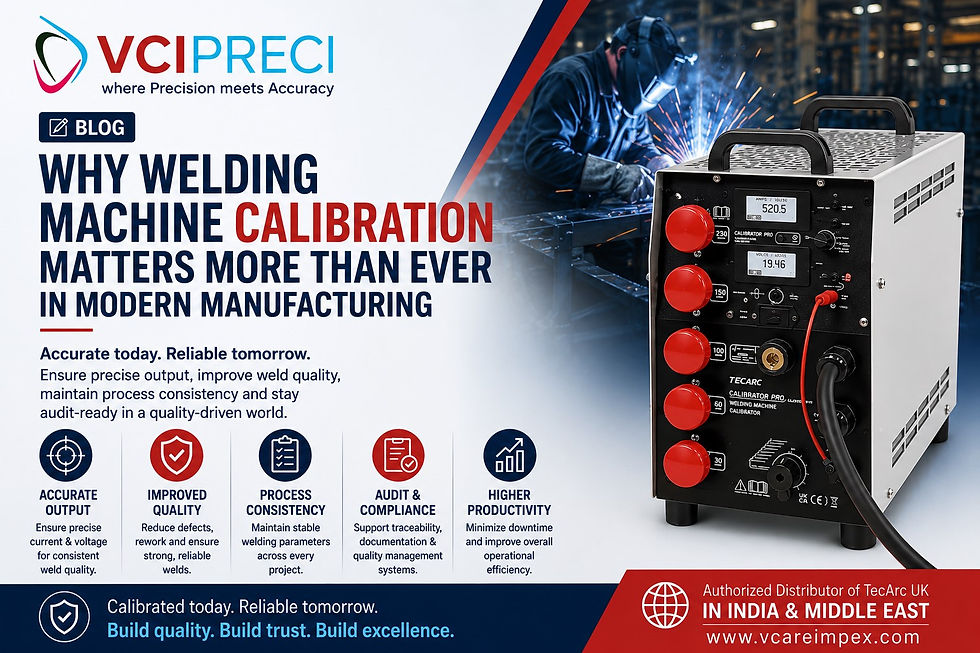
V-CARE IMPEX is the Authorized Distributor and Channel Partner for Calibrator Pro Welding Load Banks from TecArc UK in India.
We support:
Calibration Laboratories
Welding Machine Manufacturers
Service Providers
Shipyards
Heavy Engineering Companies
Oil & Gas Contractors
Defence Manufacturers
by offering professional welding calibration solutions, technical guidance, product demonstrations, and application support.
Our objective is to help Indian industries adopt modern and reliable approaches to Welding Machine Calibration, enabling organizations to strengthen their quality systems and prepare for future industrial requirements.
Conclusion
The importance of Welding Machine Calibration continues to increase as manufacturers focus on quality, repeatability, traceability, and process consistency.
Whether you are a calibration laboratory, fabrication company, welding equipment manufacturer, or industrial maintenance provider, implementing structured welding machine calibration practices can contribute to improved operational performance and stronger quality management systems.
With advanced Calibrator Pro Welding Load Banks from TecArc UK, available through V-CARE IMPEX, organizations can explore dedicated solutions designed to support professional welding machine verification and calibration programs.


Comments